


Key takeaways
- FAST stands for Free Ad-Supported Streaming TV, a model that gives viewers free access to streaming content funded by advertising.
- FAST channels typically provide scheduled, linear programming delivered over the internet, combining familiar TV viewing with digital distribution.
- FAST enables media companies and content owners to monetize existing libraries, reach new audiences, and diversify revenue.
- Unlike SVOD, FAST removes the subscription barrier and generates revenue primarily through advertising.
- Successful FAST strategies depend on strong content programming, distribution, advertising technology, analytics, and a reliable streaming platform.
The streaming industry is no longer dominated by subscriptions alone. As audiences become more price-conscious and media companies look for new ways to monetize content, FAST, Free Ad-Supported Streaming TV, has emerged as an important part of the streaming ecosystem.
FAST combines the familiar experience of scheduled television with the flexibility and accessibility of internet streaming. Viewers can access channels without paying a subscription, while advertising generates revenue for the service and content owners.
For broadcasters, OTT providers, and media companies, FAST creates another way to reach audiences, monetize content libraries, and complement existing SVOD, AVOD, and Pay TV services.
This article explains what FAST is, how FAST channels work, how they make money, and what operators should consider when launching a FAST service.
What is FAST?
FAST stands for Free Ad-Supported Streaming TV.
It refers to streaming services that provide viewers with free access to programming in exchange for watching advertisements.
FAST services often resemble traditional linear television. Content is organized into scheduled channels, and viewers tune into whatever is currently playing rather than selecting every individual program on demand.
However, unlike traditional broadcast television, FAST channels are delivered over the internet through:
- Smart TVs
- Connected TV devices
- Streaming applications
- Mobile devices
- Web browsers
This combination gives viewers the simplicity of traditional TV alongside the accessibility of streaming.
How does FAST work?
A FAST service brings together content, programming, streaming technology, distribution, and advertising.
A typical FAST workflow includes several stages.
1. Content selection
The operator identifies movies, series, news, sports, entertainment, or other programming suitable for a FAST audience.
Existing content libraries can often be repurposed to create new channel propositions.
2. Channel programming
Content is organized into a linear schedule.
Channels may focus on a particular:
- Genre
- Audience
- Franchise
- Content library
- Theme
This programming strategy gives viewers a continuous "lean-back" experience without requiring them to choose individual programs.
3. Streaming delivery
The scheduled channel is packaged and distributed over the internet to FAST platforms, applications, or Connected TV environments.
4. Advertising
Ad opportunities are inserted into the programming and sold to advertisers, creating the primary revenue stream.
5. Measurement and optimization
Operators use audience and advertising analytics to understand viewing behavior, content performance, and monetization.
FAST vs AVOD: what's the difference?
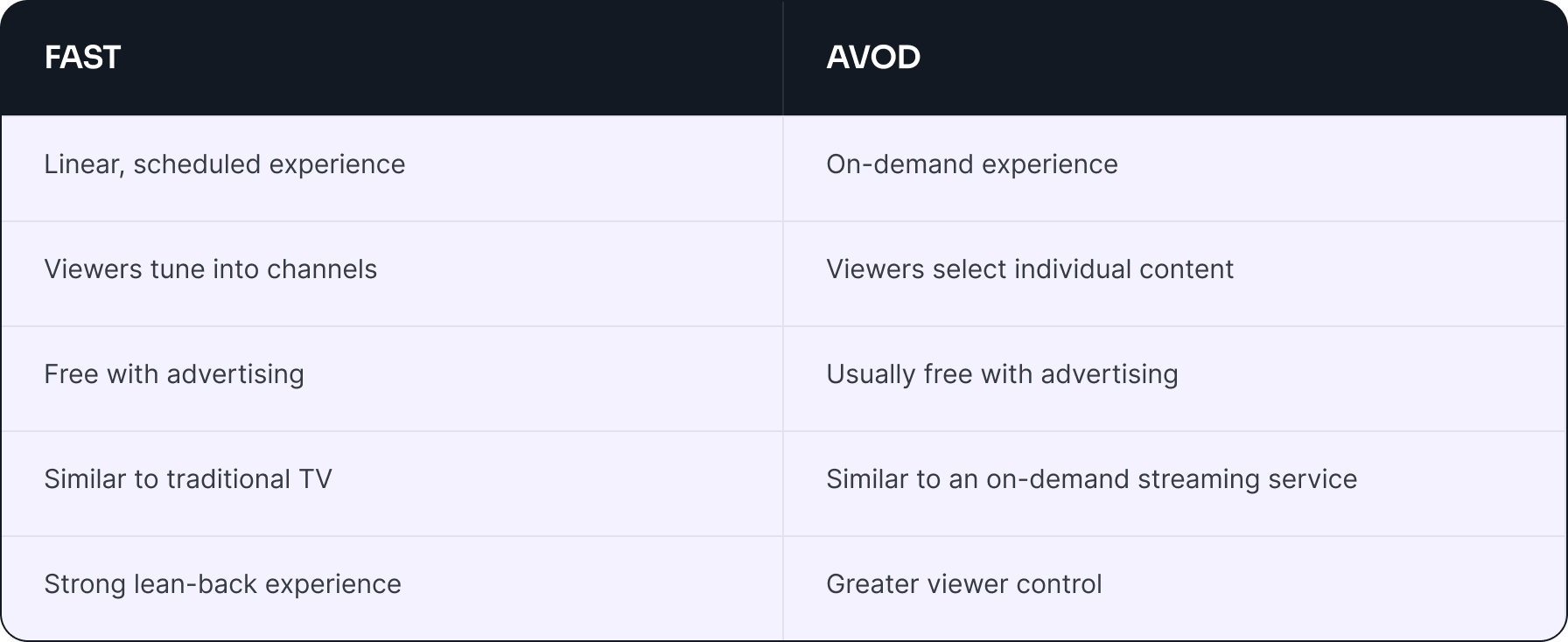
FAST and AVOD are both advertising-supported streaming models, but the viewing experience is different.
AVOD, or Advertising Video on Demand, allows viewers to select individual programs from an on-demand catalog.
FAST generally organizes programming into scheduled linear channels.
The two models can also coexist within the same streaming service.
An operator might provide FAST channels alongside an AVOD catalog, premium subscriptions, or transactional content.
FAST vs SVOD
The main difference between FAST and SVOD is how the service generates revenue.
SVOD (Subscription Video on Demand) requires viewers to pay a recurring subscription fee for access.
FAST removes that subscription requirement and relies primarily on advertising.
This creates different advantages.
FAST
- No subscription barrier
- Broad potential audience reach
- Advertising-based revenue
- Strong opportunity to monetize existing content
- Familiar linear viewing experience
SVOD
- Predictable recurring subscription revenue
- Direct customer relationship
- Typically ad-free or lower-ad experiences
- Greater dependence on subscriber acquisition and retention
Increasingly, streaming providers are combining these models rather than choosing only one.
How do FAST channels make money?
Advertising is at the heart of the FAST business model.
Instead of charging viewers directly, operators create advertising inventory within their channels and monetize viewer attention.
Modern FAST advertising can use technologies such as:
- Dynamic Ad Insertion (DAI)
- Server-Side Ad Insertion (SSAI)
- Programmatic advertising
- Audience targeting
- Contextual advertising
- Ad server integrations
This creates an important advantage over traditional linear advertising: different viewers can potentially receive different advertisements while watching the same programming.
Data and advanced advertising technologies can therefore help operators improve both ad relevance and inventory value.
Why FAST matters for media companies
FAST provides several opportunities for broadcasters, content owners, and media companies.
Monetize existing content libraries
Media companies often own significant catalogs that are no longer generating their full commercial potential.
FAST channels provide another way to package and monetize this content.
A large library can potentially support multiple themed or genre-specific channels.
Reach new audiences
Because viewers don't need a paid subscription, FAST lowers the barrier to accessing content.
This can help content owners reach audiences who may not subscribe to a premium service.
Diversify streaming revenue
Relying entirely on subscriptions can make streaming businesses vulnerable to subscriber churn and increasing acquisition costs.
FAST provides an additional advertising revenue stream that can complement:
- SVOD
- AVOD
- Pay TV
- Direct-to-consumer services
Create new content experiences
FAST also creates opportunities to package content differently.
Instead of simply making a catalog available on demand, operators can curate channels around specific genres, brands, audiences, or viewing occasions.
This can give existing content new life.
What do you need to launch a FAST channel?
Launching a FAST service requires more than creating a playlist.
Operators need an underlying technology ecosystem capable of supporting the entire channel lifecycle.
Key capabilities include:
Content management
A CMS organizes video assets, metadata, imagery, and programming information.
Channel scheduling
Operators need tools to create and manage linear programming schedules.
Video workflows
Content must be prepared, encoded, packaged, and delivered reliably.
Multi-device applications
FAST experiences need to work across Connected TVs, mobile devices, browsers, and other streaming environments.
Advertising technology
Ad servers, DAI, SSAI, and programmatic integrations enable operators to monetize available inventory.
Analytics
Audience and advertising data help teams understand what viewers watch and how channels perform.
FAST and Connected TV
FAST and Connected TV (CTV) are closely related, but they aren't the same thing.
FAST describes a streaming business and content model.
CTV describes internet-connected televisions and devices used to consume streaming content.
Connected TV has become an important environment for FAST because it brings free streaming channels directly onto the largest screen in the home.
For media companies, this creates an opportunity to deliver a television-like experience without relying exclusively on traditional broadcast or Pay TV distribution.
FAST within 24i Video Cloud
At 24i, FAST can be approached as part of a broader streaming and monetization strategy rather than as an isolated channel proposition.
24i Video Cloud brings together capabilities across applications, content management, video workflows, personalization, advertising, and data, helping operators manage streaming experiences within a connected ecosystem.
For media companies exploring FAST, this type of integrated approach can support:
- Content and metadata management
- Multi-device streaming experiences
- Advertising and Dynamic Ad Insertion
- Audience insights and analytics
- Integration with the wider streaming technology ecosystem
- Multiple monetization models within the same platform strategy
This is particularly valuable for operators that don't want FAST to exist separately from their wider direct-to-consumer, OTT, or Pay TV business.
Instead, FAST can become another component of a flexible monetization strategy alongside subscription and on-demand services.
The future of FAST
FAST reflects a broader change in the streaming market: audiences increasingly expect choice not only in what they watch, but also in how they pay for it.
As the model develops, several trends are likely to shape FAST strategies.
More sophisticated advertising
Advanced advertising will enable increasingly targeted and measurable campaigns.
Better personalization
FAST experiences can become more personalized through content recommendations, audience insights, and smarter channel discovery.
Hybrid monetization
FAST will increasingly sit alongside SVOD, AVOD, and other monetization models rather than operating independently.
Greater use of first-party data
Operators with direct audience relationships can use consented first-party data to better understand engagement and improve monetization.
The result is a model that combines elements of traditional television with the data, flexibility, and scalability of digital streaming.
Conclusion
FAST has created a new way for media companies to distribute and monetize video.
By combining free access, scheduled programming, digital delivery, and advertising, Free Ad-Supported Streaming TV offers viewers a simple way to discover content while giving operators another route to revenue.
For broadcasters, OTT providers, and content owners, FAST can help unlock additional value from existing libraries, reach new audiences, and diversify monetization beyond subscriptions.
With 24i Video Cloud, FAST can form part of a broader, connected streaming strategy, bringing content, applications, advertising, analytics, and multi-device delivery together while giving operators the flexibility to evolve their business models over time.
FAQs
What does FAST stand for?
FAST stands for Free Ad-Supported Streaming TV. It provides viewers with free streaming content funded primarily through advertising.
What is a FAST channel?
A FAST channel is a scheduled, linear streaming channel delivered over the internet. Viewers tune into programming already in progress, similar to traditional television.
Is FAST the same as AVOD?
No. FAST generally provides scheduled linear channels, while AVOD allows viewers to select individual programs on demand. Both models are funded primarily through advertising.
Is FAST free?
FAST services are generally free for viewers because advertising funds the content experience rather than a recurring subscription fee.
How do FAST channels make money?
FAST channels primarily generate revenue by selling advertising inventory. Technologies such as Dynamic Ad Insertion, programmatic advertising, and audience targeting can help optimize monetization.
What is the difference between FAST and CTV?
FAST is a streaming content and monetization model, while CTV refers to internet-connected televisions and streaming devices. FAST channels are commonly consumed through CTV devices.
Can FAST and SVOD work together?
Yes. Media companies can combine FAST with SVOD, AVOD, and other models to create hybrid streaming propositions and diversify revenue.
How can 24i support a FAST strategy?
24i Video Cloud connects applications, content management, video workflows, advertising, analytics, and multi-device delivery within a unified ecosystem, enabling operators to incorporate FAST into a broader OTT and monetization strategy.


