


Key takeaways
- A unified video streaming platform brings core capabilities such as content management, video workflows, applications, analytics, and monetization into one connected ecosystem.
- A modular OTT stack gives media companies greater freedom to select individual technology components, but can increase integration and operational complexity.
- The right approach depends on internal resources, existing technology, customization requirements, time-to-market, and growth strategy.
- Mid-sized media companies often need a balance between the simplicity of a unified platform and the flexibility of modular architecture.
- The goal should not be to minimize the number of technologies at all costs, but to create a scalable streaming architecture that can evolve without unnecessary complexity.
Building or modernizing a streaming service involves more than choosing individual features. Media companies need to decide how the underlying technology should fit together.
Two common approaches are a unified video streaming platform and a modular OTT stack.
A unified platform brings many of the capabilities required to operate a streaming service into one connected environment. A modular stack allows OTT providers to select individual technologies and integrate them into their own ecosystem.
Both can support successful direct-to-consumer services and Pay TV offerings. The difference lies in how much integration, flexibility, and operational responsibility the operator wants to manage.
So, which approach is right for your streaming business?
What is a video streaming platform?
A video streaming platform provides the technology required to manage, deliver, monetize, and optimize video services.
Depending on the provider, a platform can bring together capabilities such as:
- Content management
- Video ingestion and workflows
- Applications
- Video playback
- Personalization
- Analytics
- Advertising and monetization
- Content protection
- Multi-device streaming
The key advantage is integration.
Instead of assembling each capability independently, operators work within a connected ecosystem where different parts of the streaming service are designed to work together.
For mid-sized media companies with limited engineering resources, this can significantly reduce the amount of integration and ongoing platform management required.
What is a modular OTT stack?
A modular OTT stack takes a different approach.
Instead of relying on one video streaming platform for most capabilities, operators select technologies from multiple specialist vendors and connect them through APIs and integrations.
For example, an OTT provider might use:
- One vendor for CMS
- Another for video workflows
- A separate recommendation engine
- Multiple application frameworks
- A third-party analytics platform
- Independent advertising technology
This gives operators considerable control over the technology stack.
If a particular component no longer meets requirements, it may be possible to replace it without rebuilding the entire service.
However, that flexibility comes with additional responsibility.
Someone still needs to integrate, operate, monitor, and maintain the complete ecosystem.
Video streaming platform vs modular OTT stack
The fundamental difference between the two approaches is the balance between integration and control.
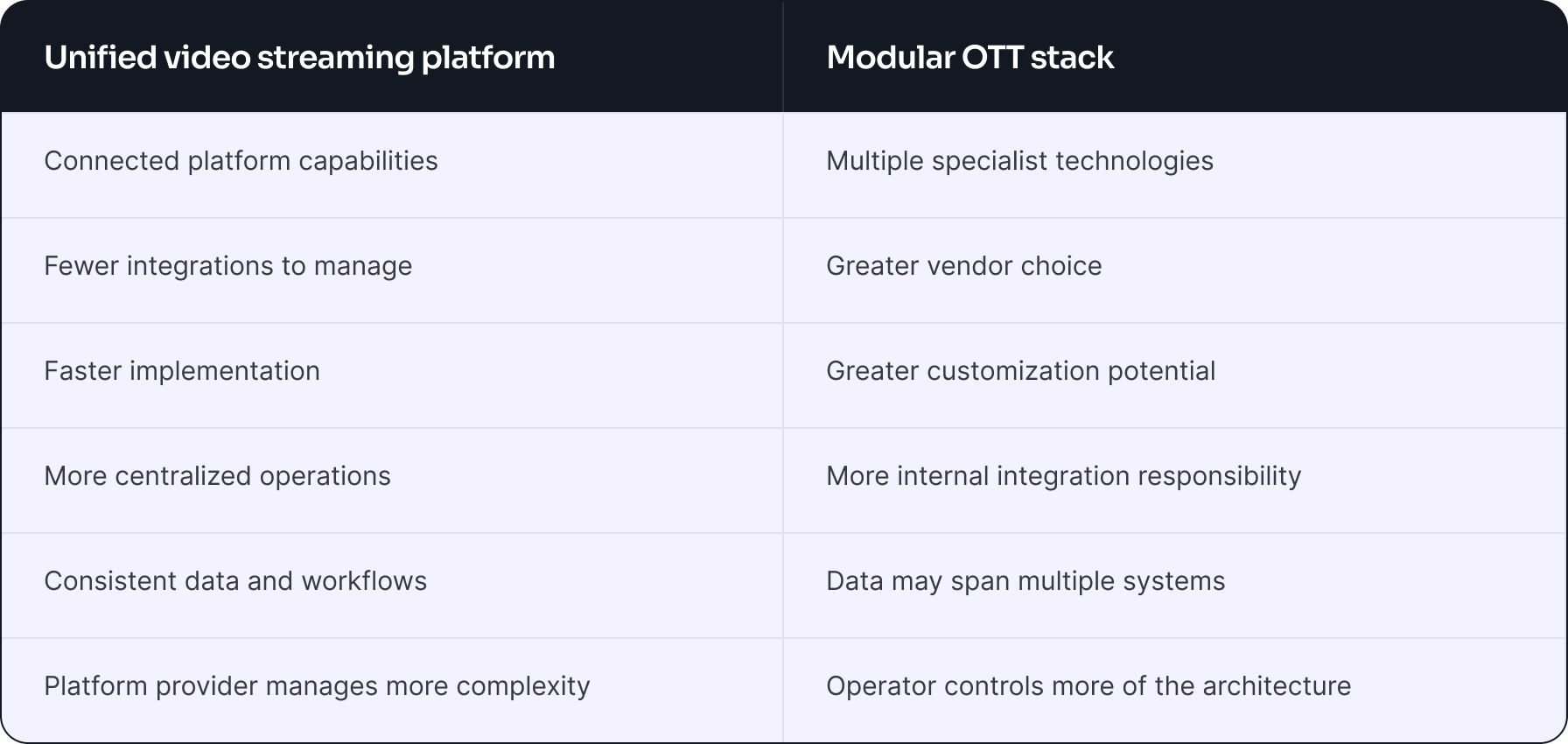
Neither model is inherently better.
The right choice depends on your organization, existing technology, and long-term streaming strategy.
1. Scalability and video delivery
Scalability should be one of the first considerations when comparing architectures.
Streaming audiences can change rapidly. Live events, breaking news, major releases, or seasonal programming can generate sudden traffic increases.
A modern architecture needs to support scalable video delivery without compromising playback quality.
Unified platforms can simplify this by providing infrastructure and workflows designed to scale together.
A modular OTT stack can offer similar scalability, but operators need to ensure that every component, and the integrations between them, can scale effectively.
The question isn't simply whether individual technologies scale. It's whether the entire service scales as one system.
2. Multi-device streaming
Viewers expect content to work consistently across:
- Smart TVs
- Mobile devices
- Web browsers
- Tablets
- Set-top boxes
- Connected streaming devices
Supporting multi-device streaming becomes increasingly complex as the number of platforms grows.
A unified video streaming platform can simplify application development and management by connecting device experiences with the same backend, content, and configuration environment.
With a modular architecture, operators may have greater freedom to customize individual applications, but maintaining consistency across devices can require additional development and QA resources.
For mid-sized media companies, the operational impact of supporting every screen should be carefully considered.
3. Integration and operational complexity
This is often where the biggest difference between the two approaches emerges.
A modular stack might provide best-of-breed capabilities at every layer, but each additional vendor introduces another integration to manage.
Over time, this can create:
- Different APIs
- Separate data models
- Multiple vendor relationships
- Disconnected reporting
- More complex troubleshooting
A unified platform reduces many of these integration points by connecting capabilities within the same ecosystem.
This doesn't necessarily mean eliminating third-party technology. Modern platforms should still allow operators to integrate specialist solutions when they add value.
The objective is to avoid fragmentation becoming an operational burden.
4. Flexibility and customization
A modular OTT stack can be attractive for organizations with highly specific requirements.
Individual components can be selected based on functionality, and internal engineering teams have greater control over how the service is assembled.
But flexibility can take different forms.
For many OTT providers, true flexibility isn't the ability to build everything themselves. It's the ability to adapt quickly when business requirements change.
A modern video streaming platform should therefore be modular enough to support:
- Existing technology integrations
- New monetization models
- Different applications and devices
- New data and analytics services
- Changing content workflows
The strongest approach can often combine platform-level integration with modular extensibility.
5. Time-to-market
For direct-to-consumer services, speed can be a major competitive advantage.
Building and integrating a modular OTT stack can require significant planning, development, testing, and vendor coordination before launch.
A unified platform can shorten this process because many core capabilities are already integrated.
This can be particularly valuable for media companies launching:
- New OTT services
- Regional offerings
- FAST propositions
- New subscription tiers
- Additional device applications
Faster deployment also allows teams to begin learning from real audience behavior sooner.
6. Internal resources and ownership
The technology architecture should match the organization operating it.
A large media company with extensive engineering resources may have the internal expertise required to manage a highly modular ecosystem.
A mid-sized operator may prefer to focus resources on content, audience growth, monetization, and customer experience.
Before choosing an approach, ask:
- Who will manage integrations?
- Who owns platform monitoring?
- Who handles application updates?
- Who coordinates vendors when something fails?
- How much engineering capacity is available for maintenance?
These operational questions are just as important as feature comparisons.
7. Total cost of ownership
A modular stack can initially appear attractive because operators can select individual technologies based on price and requirements.
But licensing is only one component of total cost.
Media companies should also consider:
- Integration costs
- Internal engineering resources
- Infrastructure
- Testing and QA
- Vendor management
- Maintenance
- Application updates
- Future migrations
A unified video streaming platform may consolidate many of these costs into a more predictable operating model.
The most useful comparison is therefore not platform price vs individual vendor price, but the total cost of operating the complete service over several years.
What should OTT providers choose?
For many OTT providers and mid-sized media companies, the answer doesn't need to be completely unified or completely modular.
A strong architecture can combine both approaches.
Core capabilities that benefit from deep integration can operate within a unified platform, while APIs and modular components allow specialist technologies to be introduced where they create meaningful differentiation.
This approach can provide:
- Faster deployment
- Reduced operational complexity
- Scalable video delivery
- Flexibility to integrate existing technology
- Consistent multi-device experiences
- Greater freedom to evolve over time
For Pay TV operators, this can also make it easier to modernize existing services without replacing every part of the technology stack at once.
Video streaming platforms and modularity at 24i
At 24i, we don't see platform integration and modularity as opposites.
24i Video Cloud is designed to bring together core streaming capabilities—including applications, content management, video workflows, personalization, advertising, and data, within a connected platform while retaining the flexibility to integrate with the wider technology ecosystem.
For OTT providers, media companies, and Pay TV operators, this approach helps reduce the complexity of managing fragmented systems without requiring every technology decision to come from a single vendor.
Operators can use the capabilities they need, integrate existing services where appropriate, and evolve their platform as their business changes.
The result is a foundation designed to support scalable direct-to-consumer services and multi-device delivery without sacrificing the flexibility needed for future growth.
Conclusion
Choosing between a unified video streaming platform and a modular OTT stack ultimately comes down to how much complexity your organization wants, and is equipped, to manage.
A modular stack offers extensive vendor choice and customization, but places greater responsibility on the operator for integration, maintenance, and ongoing orchestration.
A unified platform simplifies many of those responsibilities by connecting core capabilities and workflows within a single ecosystem.
For many mid-sized media companies, the strongest approach sits somewhere between the two: a unified, modular platform that provides a reliable foundation while remaining open enough to integrate the technologies that create genuine differentiation.
The right architecture shouldn't simply help you launch your streaming service. It should make it easier to evolve it.
FAQs
What is a video streaming platform?
A video streaming platform provides the technology needed to manage, deliver, monetize, and optimize video services across multiple devices.
What is a modular OTT stack?
A modular OTT stack combines individual technologies from multiple vendors, allowing operators to select and integrate different components for CMS, applications, analytics, advertising, personalization, and other capabilities.
Is a modular OTT stack more flexible than a unified platform?
It can provide greater control over individual technology choices, but modern unified platforms can also offer modular architectures and APIs that allow operators to integrate third-party solutions.
Which approach is better for mid-sized media companies?
It depends on internal resources and business requirements. Organizations with smaller engineering teams may benefit from a unified platform that reduces integration and maintenance, while still providing modularity where needed.
How does architecture affect multi-device streaming?
A unified platform can make it easier to maintain consistent content, functionality, and user experiences across smart TVs, mobile devices, browsers, and set-top boxes.
How does 24i combine unified and modular approaches?
24i Video Cloud connects applications, content management, video workflows, personalization, advertising, and data within a unified platform while supporting integrations with external technologies. This gives operators a connected foundation without requiring a completely closed technology ecosystem.
Download Our Ebook


